

A complete developer guide to understanding and fixing the 400 error in the Anthropic Claude API due to tool-use concurrency issues in Claude API integrations.
Introduction
After spending years building AI-powered applications and debugging API integrations, I’ve learned that Anthropic API 400 error messages are often less mysterious than they appear. One of the most frustrating issues developers encounter in 2026 is a Claude API 400 error due to tool usage concurrency issues. This error usually appears when multiple tools are executed in an unsupported or incorrectly structured environment.
If you’re seeing a Claude API bad request response while using tool calling, function calling, or MCP integrations, you’re not alone. The good news is that this problem is typically caused by request formatting, message ordering, or parallel tool execution logic—and it can be fixed systematically.
In this, you’ll learn how to fix a Claude API 400 error caused by tool concurrency issues, understand why it happens, and see real request examples that work.
“What does ‘Claude API Error 400 due to tool use concurrency issues’ actually mean?
The short answer: Claude is rejecting your request because the tool execution workflow in your payload does not match the API’s expected sequence.
When Claude returns a claude api request error with status 400, it means the request is considered invalid before the model can generate a response.
Claude Code vs OpenCode: Which AI Coding Tool Wins?
Typical error message
HTTP 400
Error
400 Bad Request
Details
Tool use concurrency issues detected
This usually happens when:
- Multiple assistant tool calls are submitted incorrectly
- tool_result message objects do not correspond to the expected tool IDs
- Parallel tool execution is attempted without proper coordination
- The request payload violates JSON request validation rules
- A tool result is sent before the associated tool call exists
- Concurrent tool execution produces an invalid message order
Why does the Claude API return a 400 tool use concurrency issue?
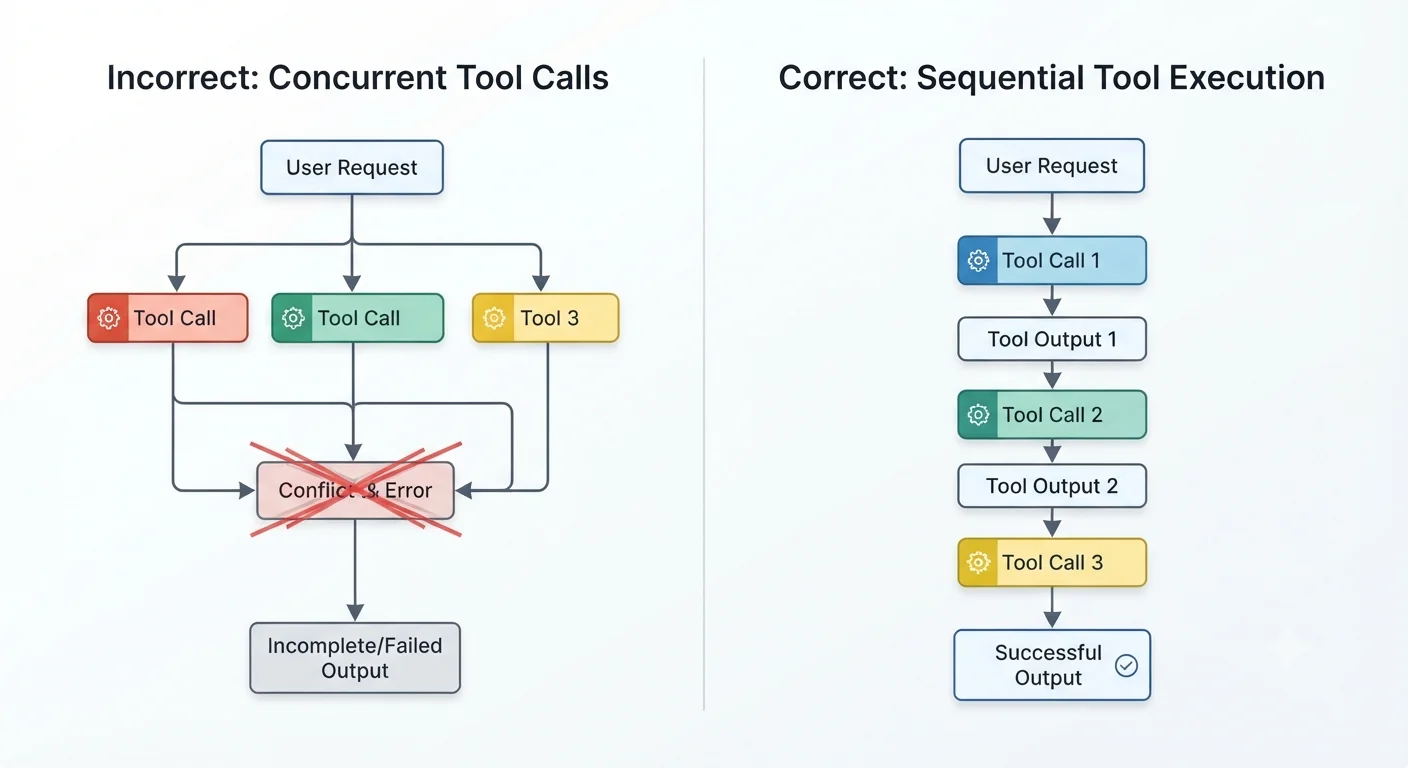
The direct answer is that Claude expects a strict conversational workflow between the assistant and the tools.
Think of it like a hotel concierge:
- You ask for a restaurant reservation.
- The concierge calls the restaurant.
- The concierge receives the confirmation.
- Only then can the concierge respond with the booking for Claude’s
In Claude’s API, the same pattern applies:
Correct sequence
Sequential
1 User sends a message
2 Assistant returns tool_use
3 Application executes the tool
4 Application sends tool_result
5 Assistant continues the conversation
If your application skips a step, duplicates a tool call, or incorrectly mixes results from multiple tools, Claude responds with a 400 Bad Request error from the Claude API. Solution requirements:
What are the most common causes of concurrency errors when using the Claude tool?
Based on real-world claude api debugging sessions, these are the most frequent causes.
1. Sending multiple tool results in the wrong order
Claude expects each tool_result to match a specific tool_use_id.
Incorrect
Order mismatch
Correct
Expected order
2. Reusing a tool_use_id
Every tool invocation must have a unique identifier.
If the same tool_use_id appears twice, the request may fail validation.
3. Executing tools concurrently without coordination
This is the classic Claude tool use concurrency problem.
Imagine two asynchronous tasks finishing at different times:
If the resulting payload is assembled incorrectly, Claude may reject it with a “claude api tool, using concurrency error” fix requirements.
4. Invalid JSON structure
A surprising number of Claude API tool use error reports are actually due to malformed JSON.
Common mistakes:
- Missing commas
- Extra braces
- Wrong field names
- Nested arrays in the wrong location
- Invalid UTF-8 characters
How can you identify the exact source of the error?
The fastest approach is to validate three things in order.
Step 1: Validate the JSON
Start here
Use a JSON validator before sending the request.
Check for:
- Proper quotation marks
- Balanced braces
- Valid arrays
- Required fields
Step 2: Validate tool IDs
Critical
Ensure every tool_result references an existing tool_use_id.
Step 3: Validate message order
Most common issue
The correct order is:
1 User message then
2 Assistant tool_use then
3 Tool result then
4 Assistant response
What does a valid Claude tool-calling request look like?
Here’s a simplified example of a correct Claude function calling workflow.
Step 1: User request
Step 2: Assistant requests a tool
Step 3: Application returns the tool result
Step 4: Assistant completes the answer
This sequence passes API request validation and avoids concurrency issues with tool use.

What does an invalid concurrent request look like?
Here is an example that often triggers errors when using the Anthropic tool.
Problematic request
Will fail
The issue is that Claude never received the corresponding tool_use calls for weather_1 and flights_1 in the current conversation state.
How do you fix concurrent tool use in the Claude API?
The safest fix is to process tool calls sequentially unless you have a robust orchestration layer.
Instead of this:
Use this:
This approach dramatically reduces concurrent tool execution errors and makes API response handling much easier to debug.
What are the best practices for using Claude in 2026?
Recommended practices
2026
Use sequential tool calls by default
Parallel execution should only be used when your orchestration logic guarantees correct ordering.
Log every tool_use and tool_result
Store the full request payload during development.
Validate JSON before sending
Automated validation catches many request payload error issues.
Generate unique tool IDs
Use UUIDs or timestamp-based identifiers.
Preserve conversation state
Never drop previous assistant tool calls from the message history.
Follow the latest Claude developer guide.
Anthropic occasionally updates the AI model, calling behavior, and validation rules.
Quick debugging checklist for Claude API Error 400
Run through these checks
Before retrying
- JSON is valid
- All required fields are present
- Each tool_use_id is unique
- Each tool_result references an existing tool call
- Message order is correct
- No duplicate tool results
- No orphaned tool IDs
- Conversation history is complete
- Parallel tool execution is coordinated
- Request size is within API limits
How should you handle parallel execution of tools without triggering Claude API errors?
The short answer is: only run tools in parallel when your application can reliably follow Claude’s expected conversation flow. Parallel execution can improve performance, but it also increases the risk of mismatched tool_use and tool_result messages.
How to Set Up DeepSeek on Janitor AI (2026 Step-by-Step Guide)
Many developers assume Claude automatically understands asynchronous tool responses. In reality, your application is responsible for collecting those responses and returning them in the correct format.
Sequential vs. parallel tool execution
| Feature | Sequential Tool Calls | Parallel Tool Execution |
|---|---|---|
| Complexity | Low | High |
| Performance | Moderate | Fast |
| Risk of API Error 400 | Very Low | Higher |
| Easier Debugging | ✅ Yes | ❌ No |
| Recommended for Beginners | ✅ Yes | No |
| Production Ready | ✅ Yes | Yes, with proper orchestration |
For most applications, sequential tool calls are the safest choice. Once your workflow is stable, you can selectively introduce parallel execution where it genuinely improves performance.
How does executing the MCP tool affect the Claude API?
If you’re using the Model Context Protocol (MCP), the same rules still apply.
MCP standardizes tool integration, but it doesn’t eliminate the need for valid message ordering. Each tool request must still have:
- A unique tool identifier
- A matching tool result
- Proper conversation history
- Valid JSON formatting
When developers report an Anthropic tool use issue while using MCP, the root cause is usually an application workflow problem rather than an MCP limitation.

Common MCP mistakes
- Sending multiple unfinished tool requests
- Losing conversation state between requests
- Returning partial tool results
- Reusing expired tool IDs
- Interrupting the tool execution chain
What are the most common Claude API debugging mistakes?
The quickest answer is that most debugging sessions focus on the wrong thing. Developers often inspect the API response while ignoring the request payload that triggered the error.
Here are some of the biggest mistakes.
1. Ignoring the complete request payload
Always log the entire request before sending it.
Without the full payload, it’s nearly impossible to reproduce a Claude API request error.
2. Logging only the error message
This is a common mistake.
Instead of saving only:
400 Bad Request
Also save:
- Request body
- Headers
- Conversation history
- Tool definitions
- Tool IDs
- Timestamp
- Response body
These details make AI API debugging significantly easier.
3. Forgetting previous assistant messages
Claude relies on conversation history.
Removing earlier assistant messages can produce an invalid tool request because Claude no longer recognizes the referenced tool.
4. Changing tool definitions mid-conversation
If your application modifies available tools halfway through a conversation, Claude may reject subsequent requests.
Keep tool definitions consistent until the interaction is complete.
How can you build a more reliable Claude API workflow?
The best approach is to design your application around a predictable workflow rather than reacting to API errors after they occur.
A reliable workflow looks like this:
- Ruser’s the user’s request.
- Send it to Claude.
- Detect any tool-use instructions.
- Execute each requested tool.
- Collect the results.
- Return the corresponding tool_result messages.
- Requde’s final response.
- Deliver the completed answer to the user.
This process keeps your API workflow optimization clean and minimizes unexpected failures.
Which developer best practices help prevent future API errors?
Following a few consistent habits can prevent most Claude API bad-request problems before they happen.
Recommended developer best practices
- Validate every request before sending it.
- Keep message history intact.
- Generate unique IDs for every tool invocation.
- Avoid unnecessary parallel execution.
- Implement structured logging.
- Use retry logic only for temporary failures.
- Handle API responses gracefully.
- Test edge cases before deploying to production.
- Keep SDKs and dependencies updated.
- Monitor API changes from Anthropic.
These practices not only reduce errors in using the Claude API but also improve long-term application stability.
How can you troubleshoot the Claude API Error 400 stby step by step?
If you’re stuck, follow this checklist before making any code changes.
Claude API debugging checklist
✅ Is your JSON valid?
✅ Are all required fields included?
✅ Does every tool_result reference a valid tool_use_id?
✅ Are tool IDs unique?
✅ Is the message order correct?
✅ Are previous assistant messages preserved?
✅ Are tool definitions unchanged?
✅ Are parallel tool calls synchronized correctly?
✅ Are you sending the complete conversation history?
✅ Have you reviewed the latest API documentation?
If every “answ” r is “Yes,” your integration should pass API request validation in most situations.

What mistakes should you avoid when implementing Claude function calling?
Even experienced developers occasionally introduce small issues that lead to difficult-to-diagnose failures.
Avoid these common mistakes:
- Executing tools before Claude requests them
- Sending duplicate tool_result messages
- Returning incomplete JSON
- Removing conversation context
- Reusing identifiers
- Ignoring validation errors
- Assuming asynchronous responses can be returned in any order
- Mixing tool definitions from different conversations
Careful implementation of the Claude function calling makes your application more reliable and easier to maintain.
Why is proper API response handling so important?
Many developers focus only on sending requests correctly, but handling API responses is equally important.
Your application should:
- Detect unsuccessful responses.
- Log useful debugging information.
- Display meaningful error messages.
- Retry only when appropriate.
- Avoid creating duplicate tool requests.
Strong response handling improves the overall user experience and simplifies future maintenance.
Frequently Asked Questions
Why does the Claude API return a 400 Bad Request?
A 400 Bad Request usually indicates that the request payload is invalid. Common causes include malformed JSON, incorrect message order, missing fields, or tool-use concurrency issues.
What is tool-use concurrency in the Claude API?
Tool-use concurrency occurs when multiple tool requests or results are processed simultaneously without preserving the expected conversation sequence, leading to validation failures.
Should I use sequential or parallel tool calls?
For most applications, sequential tool calls are recommended; they’re easier to debug and less likely to trigger request validation errors. Parallel execution is best reserved for advanced workflows with proper orchestration.
Can malformed JSON cause a Claude API Error 400?
Yes. Even a small formatting mistake, such as a missing comma or an incorrect field name, can cause a Claude API 400 error before the request reaches the model.
Does MCP eliminate tool use errors?
No. MCP simplifies tool integration, but developers must still maintain correct conversation history, tool IDs, and message ordering.
How can I debug Claude API requests more effectively?
Log the complete request payload, conversation history, tool definitions, response body, and timestamps. This information makes it much easier to identify the source of the problem.
Are tool IDs required to be unique?
Yes. Every tool invocation should use a unique identifier so Claude can correctly associate each tool_result with its corresponding tool_use.
Where can I learn more about Claude API best practices?
The official Anthropic documentation is the best source for current guidance on tool calling, request validation, and API updates. Review it regularly because validation rules and recommended workflows may evolve.
Conclusion
Encountering a Claude API error 400 due to tool-use concurrency issues can be frustrating, especially when your application appears to be working correctly. However, in most cases, it isn’t with Clait itself—it’s with how requests are structured, validated, or sequenced.
By understanding how tool-use concurrency issues arise, preserving conversation history, validating your JSON payloads, and following a predictable tool-calling workflow, you can eliminate most Anthropic API 400 responses before they reach production.
Whether you’re building AI assistants, automation platforms, coding tools, or enterprise applications, investing time in proper request validation and workflow design will pay off through fewer errors, easier debugging, and a more reliable user experience.
As Anthropic continues to improve Claude’s capabilities throughout 2026, keeping your integrations aligned with current developer best practices will help ensure your applications remain stable, scalable, and ready for future updates.
Which AI Skills Do Technical Post-Sales Leaders Need in 2026?
DrovenIO AI for Business Review: Features, Pricing & Benefits
Broken Keyboard Grok Answer: Grok Academy’s Python Exercise Explained (2026)