
The Agentic AI Gold Rush Has a Quiet Failure Problem
Every week brings another agent framework, another “autonomous AI” launch, another demo of an agent booking flights or writing code end-to-end. Teams are racing to ship something agentic before a competitor does. And beneath the excitement, a pattern is emerging in engineering retrospectives and post-mortems that doesn’t make it into the launch tweets: many of these projects quietly stall.
Not because the models are weak. Not because the frameworks are broken. Because the project never started with a real problem — it started with a technology, and someone went looking for a use case to justify it afterward.
That backward sequence is the actual subject of this guide. Building agentic AI applications with a problem-first approach isn’t a buzzword — it’s a correction to the most common mistake in agentic AI development right now.
The Myth: “Pick the Right Agent Framework First”
Here’s the instinct almost every team has, and it feels completely reasonable in the moment: open a comparison of agent frameworks, pick one based on GitHub stars or vendor blog posts, spin up a proof of concept, and then figure out what to point it at.
It feels like progress. You’re writing code. You have a working demo by Friday. Leadership is impressed.
The problem shows up three months later, when the demo can’t handle a real customer’s messy input, nobody agreed on what “success” means, and the “autonomous” agent needs a human to babysit every output anyway — except now there’s no plan for that, because the human-in-the-loop step was never designed in.
Framework-first thinking optimizes for a working demo. Problem-first thinking optimizes for a working application. Those are not the same target, and agentic AI development is unforgiving about the difference because agents don’t just answer questions — they take actions, chain decisions, and can fail in compounding ways.
What Problem-First Actually Means for Agentic AI
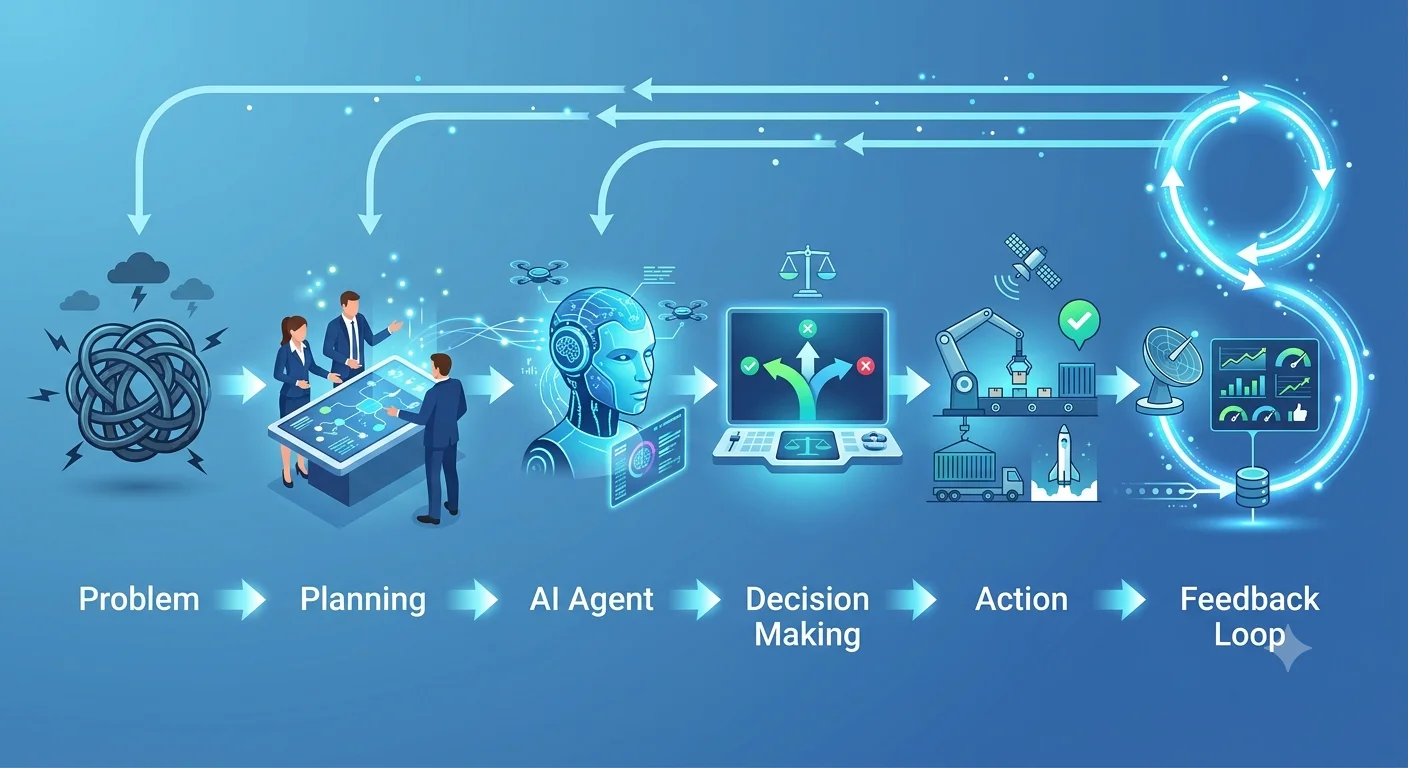
A problem-first approach means you don’t touch tooling, orchestration, or model choice until you can answer three questions in plain business language:
- What decision or workflow is currently slow, error-prone, or too expensive to scale with humans alone?
- What does “solved” look like, measured in business terms — hours saved, error rate reduced, tickets closed — not model accuracy?
- How much autonomy does this specific problem actually require, versus how much autonomy would just be impressive?
Only after those are answered do architecture, agent memory, retrieval-augmented generation, and orchestration tooling enter the conversation.
| Starting point | A framework or model | A specific, bounded workflow problem |
| First deliverable | A working demo | A written problem definition and success metric |
| Autonomy level | Maximized to look impressive | Matched to the actual risk and complexity of the task |
| Human role | Added later, if at all | Designed in from step one |
| Common failure mode | Demo that can’t survive real inputs | Slower start, but survives contact with production |
| Success measured by | Model output quality | Business outcome change |
The Problem-First Framework: 6 Steps to Build Agentic AI Applications That Actually Work
This is the practical core of a problem-first AI development process. It’s not tied to any single agent framework — it applies whether you’re building on graph-based orchestration, a multi-agent system, or a single well-scoped autonomous workflow.
Step 1: Find a Bounded, High-Friction Workflow
Don’t start with “let’s make an AI agent.” Start by listing workflows where a human currently makes repeated judgment calls using information scattered across multiple systems — support triage, invoice reconciliation, vendor research, compliance checks. Bounded beats broad. A narrow, well-defined problem is easier to give real autonomy to; a vague one produces a vague agent.
Step 2: Map the Human Process Before Automating It
Before any AI application design happens, document how a competent human actually does this task today, step by step, including the exceptions and edge cases they handle by instinct. This map becomes your agent’s task decomposition. Skipping this step is the single biggest reason agentic workflows break on real-world inputs — the team never wrote down what “handling it correctly” actually involves.
Step 3: Define Success in Business Terms, Not Model Metrics
“The agent should be accurate” isn’t a target. “Reduce manual invoice review time by 40% while keeping error escalations under 2%” is. Defining this before development keeps the project honest later, and it’s the metric that will actually secure the project’s renewal funding — not a benchmark score that nobody outside engineering understands.

Step 4: Decide How Much Autonomy the Problem Actually Needs
Not every workflow needs a fully autonomous multi-agent system. Some need a single tool-using assistant with a human approval step. Some genuinely need multi-step planning and autonomous execution across systems. Matching autonomy to actual risk — rather than defaulting to maximum autonomy — is what separates enterprise AI agents that survive audits from ones that get quietly switched off.
Step 5: Choose Architecture and Tools Last
This is where framework selection, retrieval-augmented generation, agent memory design, and orchestration choices finally belong. By this point, you know the task shape, the data sources involved, and the risk tolerance — so the tooling decision is grounded rather than arbitrary. This is also the stage where AI tool integration and orchestration patterns should be evaluated against the problem’s requirements, not the other way around.
Step 6: Build a Human-in-the-Loop Checkpoint from Day One
Even a highly autonomous agent needs a designed moment where a human can review, override, or escalate — not bolted on after an incident. This isn’t a limitation on agentic AI; it’s what makes autonomous AI systems trustworthy enough to get deployed in production and stay there.
What a Problem-First Agentic App Looks Like in Practice
Picture a mid-sized company drowning in vendor contract reviews — a legal ops team manually checking renewal terms, flagging risky clauses, and routing exceptions to lawyers. A tech-first team would start by picking a multi-agent framework and building something flashy that “reads and negotiates contracts autonomously.”
A problem-first team starts differently: they interview the legal ops staff, map exactly which clause types get flagged and why, define success as “reduce first-pass review time without increasing missed risk clauses,” and only then decide the agent needs retrieval over a clause library, a scoring step, and a mandatory lawyer sign-off before anything gets sent externally. The resulting system is less dramatic in a demo — and far more likely to still be running a year later.
That gap between “impressive demo” and “still running a year later” is the entire argument for problem-first AI development.

Where Even Problem-First Teams Still Go Wrong
Getting the sequence right doesn’t guarantee success. Watch for these:
- Scope creep after the pilot works. A narrow, successful pilot gets expanded to “handle everything” before the team validates the harder edge cases.
- Treating the success metric as fixed. Business context shifts; metrics defined in month one should be revisited rather than treated as permanent.
- Underestimating AI governance needs. Autonomous systems making real decisions need audit trails and override logs, not just a good initial design.
- Skipping change management. The best agentic workflow still fails if the humans who are supposed to trust and use it weren’t part of defining it.
Problem-First Readiness Checklist
Before writing a single line of agent code, confirm you can check off all of these:
- The problem is written down in one sentence that a non-technical stakeholder would understand
- Success is defined as a measurable business outcome, not a model score.
- The current human process has been mapped, including edge cases.
- Required autonomy level has been explicitly discussed and agreed upon, not assumed.
- A human-in-the-loop checkpoint is designed, not deferred.
- At least one stakeholder outside engineering has reviewed the plan.
- Only after all of the above: framework, architecture, and tooling decisions are made
If you can’t check every box, you’re still in tech-first territory — even if it doesn’t feel like it.
FAQ
Is a problem-first approach slower than just building a demo?
The demo comes slower, yes. The working, production-ready application usually comes faster overall, because you skip the rebuild cycle that tech-first projects hit once real inputs show up.
Does problem-first mean avoiding multi-agent systems?
No. It means a multi-agent architecture is chosen because the problem genuinely requires coordinated, specialized agents — not because it looks more advanced.
Can this framework apply to a solo developer, not just an enterprise team?
Yes. The six-step scale-down process works well; a solo builder moves through it faster and interviews fewer stakeholders.
Where does retrieval-augmented generation fit into this process?
It’s a tool choice, which is why it belongs in Step 5 — selected once you know what information the agent actually needs to retrieve, not selected by default.
The Takeaway
The mistake isn’t agentic AI itself — it’s sequencing. Teams that start with a framework end up with an impressive demo and an unclear reason for its existence. Teams that start with a real, bounded problem end up with something narrower, less flashy in a pitch deck, and far more likely to survive contact with production.
If there’s one habit to take from this: the next time an agentic AI project kicks off, resist opening a framework comparison tab first. Open a blank document and write down, in one sentence, the problem you’re actually trying to solve. Everything else — architecture, autonomy level, orchestration, tooling — should follow from that sentence, not lead it.
Which AI Skills Do Technical Post-Sales Leaders Need in 2026?
15 Best AI Tools for Content Creation in 2026 (Tested & Reviewed)
What are the Best AI Tools for business workflow analysis process mapping in 2026?