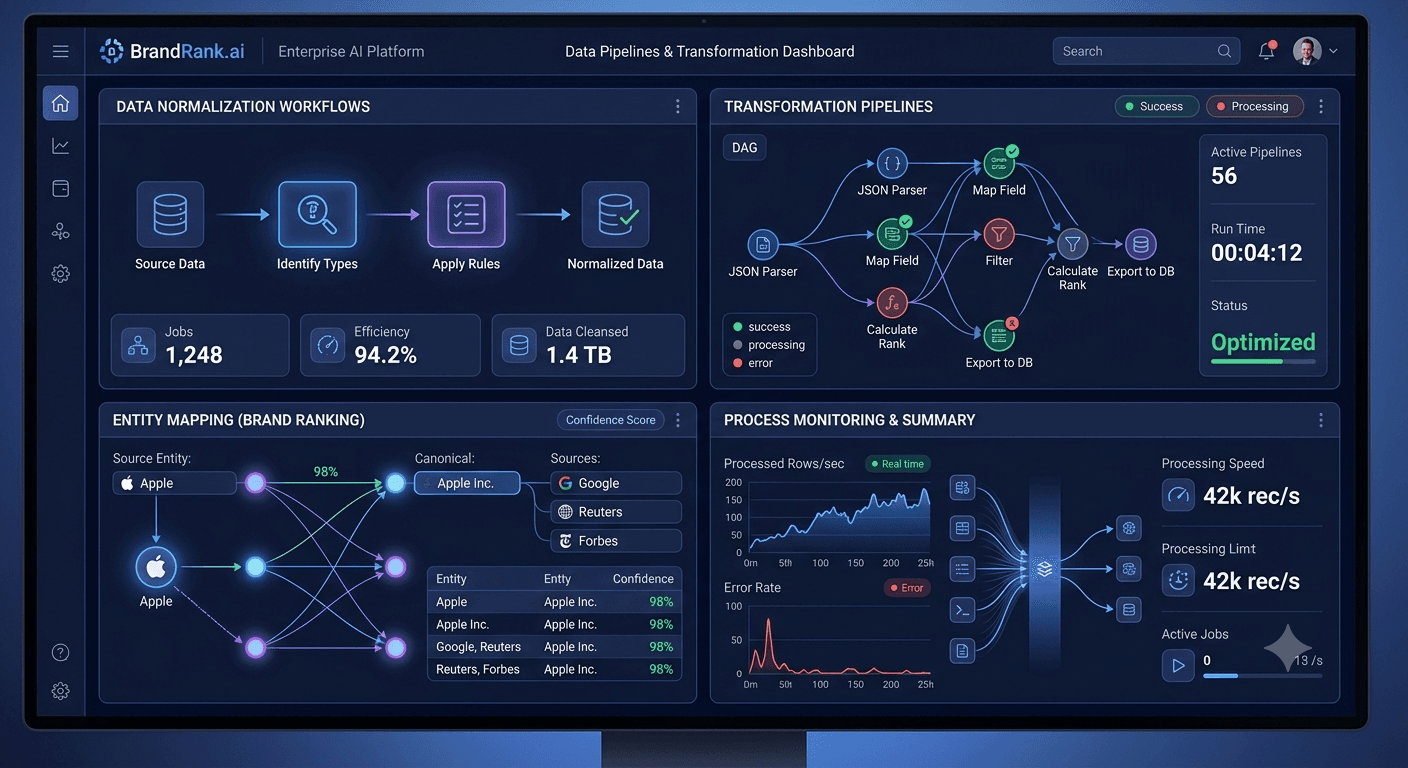
If you’ve searched this phrase, you’ve probably already noticed something strange: dozens of articles use it confidently, but almost none of them point to a document where BrandRank.ai actually defines it. This guide reviewed BrandRank.ai’s public site, its press coverage, and the wider technical literature on entity normalization before writing a single word — and it’s going to tell you the truth about what’s documented and what isn’t, rather than inventing a rulebook to fill the gap.
That distinction matters more in 2026 than it did two years ago. AI answer engines like ChatGPT, Gemini, Claude, and Perplexity now generate direct answers instead of link lists, and platforms like BrandRank.ai exist specifically to measure whether your brand gets cited accurately inside those answers. Whether or not a specific “transformation rules” framework exists, the underlying problem — messy, inconsistent brand data confusing AI systems — is real and solvable.
What you’ll learn:
- Why “BrandRank.ai normalization transformation rules” isn’t a published technical framework, and what BrandRank.ai actually does document
- What entity normalization really means, with concrete before/after examples
- A practical, tool-agnostic system for cleaning brand data so AI systems cite you correctly
- Where this practice helps, where it doesn’t, and what it can’t fix
- A comparison of platforms working in this space
What Is Actually Documented vs. What Isn’t
Direct answer: BrandRank.ai is a real SaaS platform that measures brand visibility, citation frequency, and content readiness across AI answer engines. However, it does not publish a named technical specification called “normalization transformation rules.” That exact phrase appears to have originated from SEO content sites, not from BrandRank.ai itself.
This is worth stating plainly because it changes how you should read everything that follows this section. BrandRank.ai’s public materials describe scoring categories — AI visibility, content readiness, vulnerability — measured against a defined set of tracked prompts across engines. That part is verifiable.
What isn’t verifiable is a specific, named rulebook of “transformation rules” that BrandRank.ai applies internally. The company, like most SaaS platforms with proprietary scoring, doesn’t publish its exact matching or scoring logic. That’s normal — Google doesn’t publish its full ranking algorithm either — but it means anyone claiming to lay out BrandRank.ai’s “rules” in granular detail is speculating, not reporting.
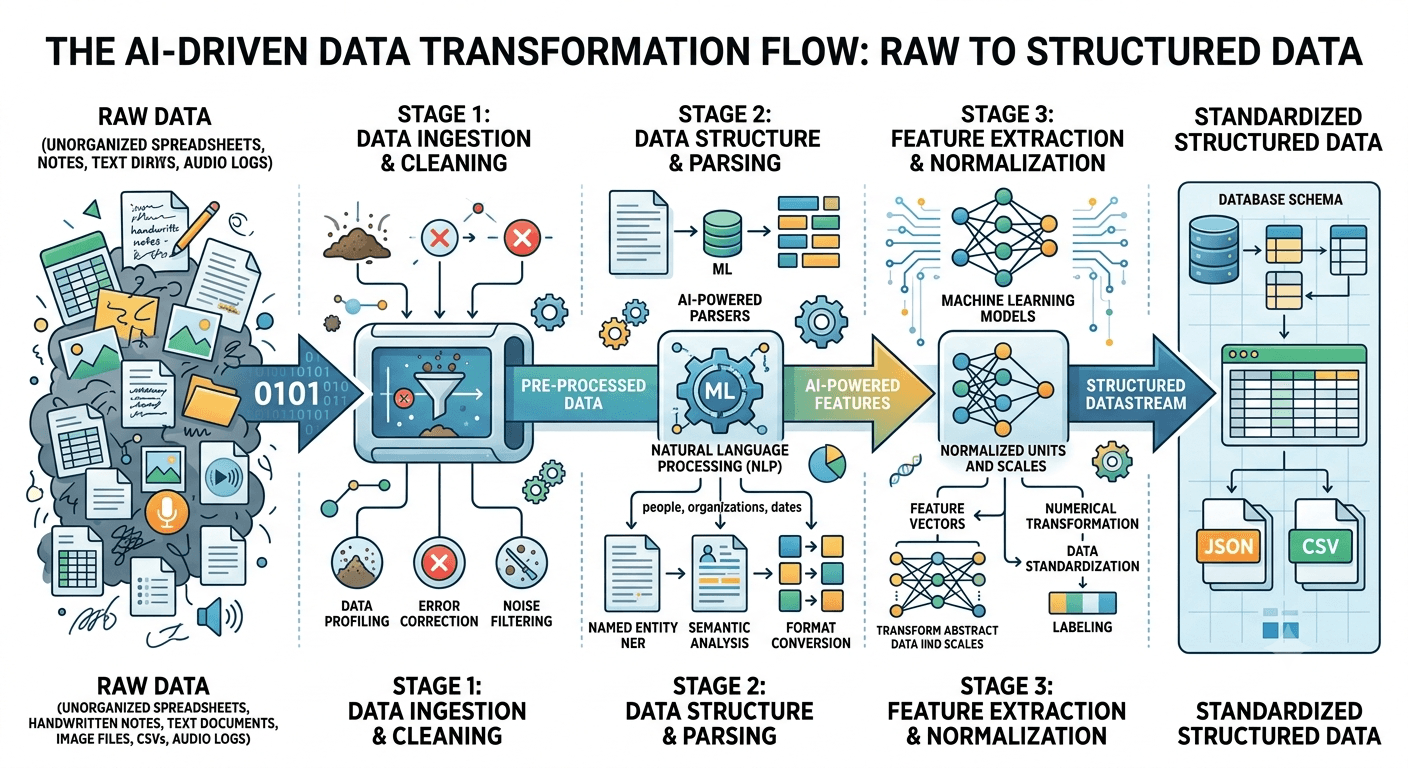
Practical takeaway: Treat this phrase as shorthand for a real, useful discipline — entity normalization for AI visibility — rather than as a lookup for a BrandRank.ai product manual. The rest of this guide focuses on that real discipline, because it’s the part you can actually act on.
What Does “Normalization” Mean in This Context?
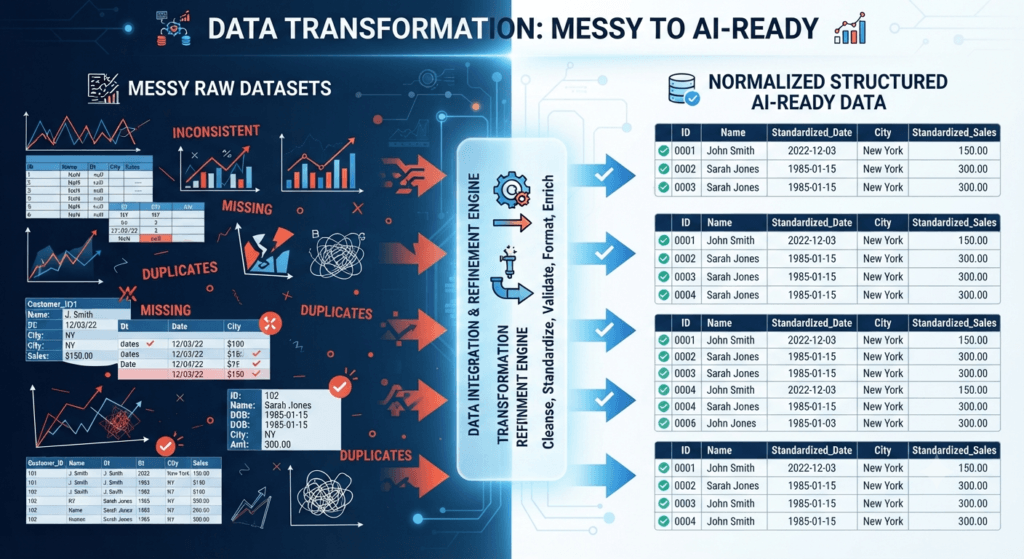
Direct answer: Normalization is the process of converting inconsistent variants of the same information — brand names, addresses, product names, dates — into one standardized, canonical form so a computer system can recognize them as identical.
Humans do this instinctively. If you read “Salesforce,” “SFDC,” and “salesforce.com” in three different articles, you know they refer to one company. A machine-learning system doesn’t get that for free — it has to be taught, or it has to infer it statistically, and either approach can fail on edge cases.
Practical example: A mid-size SaaS company might appear online as “Acme Corp,” “Acme Corporation,” “Acme, Inc.,” and “acme.io” across its own site, review platforms, press releases, and directories. Without normalization, an AI system parsing the web may treat these as four distinct entities, diluting citation confidence across the board.
Real-world scenario: A regional bank rebranded in 2023, dropping “First” from its name. Two years later, some directories, Wikipedia mirrors, and older press releases still used the old name. When customers asked AI assistants about the bank’s mortgage rates, some answers cited outdated entity information tied to the old name — because the older mentions hadn’t been resolved to the current entity.

Common mistake: Treating rebrands, mergers, or legal-suffix cleanup as a one-time task. Entity resolution has to run continuously because new inconsistent mentions appear every time someone writes about you.
Best practice: Maintain one canonical source of truth — usually your own site’s structured data (via Schema.org’s Organization markup) — and treat every other mention as something to reconcile against it, not the other way around.
How Entity Normalization Works Behind the Scenes
Direct answer: Normalization systems typically combine rule-based matching (exact-string and alias dictionaries) with AI-based semantic matching (embedding similarity, fuzzy matching) to decide whether two mentions refer to the same entity, then collapse them into a single canonical record.
Rule-based matching is fast and predictable. You build a dictionary — “SFDC” → “Salesforce,” “IBM” → “International Business Machines Corporation” — and the system does a direct lookup. It works well for known variants but breaks down the moment it meets a variant nobody anticipated.
AI-based matching fills that gap. Instead of an exact dictionary lookup, it uses semantic similarity to judge whether two text spans likely refer to the same entity, even if the exact wording has never been seen before. This is closer to how large language models themselves reason about entities, which is part of why it correlates better with how AI answer engines actually behave.
Expert insight: Neither approach alone is sufficient at scale. Rule-based dictionaries need constant maintenance as brands rebrand, merge, or launch new products; AI matching needs oversight because it can occasionally merge two genuinely distinct entities that happen to look similar (a classic false-positive failure mode in entity resolution work, well documented in the broader data-quality literature that groups like NIST and IBM have published on record linkage).
Decision framework: If your brand has fewer than a handful of known naming variants and a stable structure, a maintained dictionary is probably enough. If you operate across multiple markets, languages, or have a complex history of M&A activity, you need semantic matching layered on top, with human review of edge cases.
Common mistake: Overwriting the original raw mention when normalizing, instead of preserving it alongside the canonical version. This makes it impossible to audit decisions or roll back an incorrect merge later.
Actionable takeaway: Whatever tool or process you use, keep a mapping table — raw variant → canonical form — rather than a lossy one-way transformation. You’ll need it to debug misattributions later.
Why This Matters for AI Visibility in 2026
Direct answer: AI answer engines synthesize a single response from many sources rather than presenting a ranked list, so if those sources disagree about basic facts — your name, your category, your current offerings the model may produce an inaccurate or diluted answer, or fail to cite you with confidence at all.
This is a structural shift, not a marketing trend. Traditional search lets users compare 10 results and judge credibility themselves. Answer engines compress that judgment into a single generated response, which means the underlying data quality behind that response matters more, not less.

Business implication: A well-normalized brand presence doesn’t guarantee an AI system recommends you — no legitimate vendor can promise that — but it removes a class of failure where you’d otherwise be invisible or misattributed for reasons that have nothing to do with your actual product quality.
Technical implication: Structured data markup (Schema.org’s Organization, Product, and LocalBusiness types) gives crawlers and AI training pipelines an explicit, machine-readable canonical record, rather than forcing them to infer your identity from unstructured prose. This is one of the few genuinely evidence-backed levers available, since it’s directly documented by Schema.org and referenced in Google’s own structured data guidelines.
Common misconception addressed here: Many marketers assume AI visibility is primarily about content volume. Volume without consistency can backfire — more mentions mean more chances for conflicting information to confuse entity resolution.
A Practical Framework You Can Apply Today
Direct answer: A workable brand-normalization process has five stages: audit your current mentions, define one canonical record, build a variant-mapping dictionary, implement structured data, and monitor for drift on a recurring schedule.
Step 1 — Audit. Search your brand name, past names, and common misspellings across search engines and a few AI assistants. Note every variant: legal suffixes, abbreviations, old addresses, discontinued product names.
Step 2 — Define the canonical record. Pick the exact legal name, primary domain, current address, and category description you want treated as ground truth. This becomes your Organization schema source of truth.
Step 3 — Build the variant dictionary. List every known alias and map it explicitly to the canonical record. Include common misspellings and former names from any rebrand or acquisition.
Step 4 — Implement structured data. Add or update Schema.org markup on your primary domain, ensuring the sameAs property links out to verified profiles (LinkedIn, Wikipedia, Crunchbase) that reinforce the same canonical identity.
Step 5 — Monitor and re-audit. Set a quarterly reminder to re-run your audit. New mentions, new directories, and new AI-generated summaries of your brand appear continuously; normalization is maintenance, not a one-time project.
Implementation Checklist
| Task | Owner | Frequency |
|---|---|---|
| Audit brand mentions across search and AI tools | Marketing/SEO | Quarterly |
Update canonical Organization schema | Dev/IT | On any name, address, or category change |
| Maintain variant-to-canonical mapping dictionary | Data/Marketing | Ongoing |
Verify sameAs links to third-party profiles | Marketing | Semi-annually |
| Review AI-generated answers about your brand for accuracy | Brand/PR | Monthly |
Platform Comparison
| Platform | Primary Focus | Free/Paid | Best For | Content Depth | Strengths | Limitations |
|---|---|---|---|---|---|---|
| BrandRank.ai | AI visibility, citation tracking, content readiness scoring | Paid (enterprise-oriented) | Brands wanting ongoing AI-citation monitoring | Moderate — dashboard-driven, not open documentation | Tracks multiple AI engines; vendor reports notable visibility gains from its recommendations | Proprietary scoring methodology isn’t public; no published “rules” framework to audit |
| Schema.org markup (self-implemented) | Structured entity definition | Free | Any business, any size | High — official, openly documented spec | Free, standards-based, directly used by search and AI crawlers | Requires manual implementation and ongoing maintenance |
| ETL/data tools (dbt, Fivetran, Airbyte) | General-purpose data pipeline normalization | Paid (usage-based) | Engineering teams normalizing data at pipeline scale | High for structured data, not brand-specific | Flexible, integrates with existing data stacks | Not purpose-built for brand entity resolution specifically |
| Manual brand audit | Ad hoc entity consistency review | Free (time cost only) | Small businesses, early-stage brands | Low to moderate | No cost, full control | Doesn’t scale, easy to miss variants, no automated monitoring |
Note: Reported performance figures for any commercial platform, including BrandRank.ai, come from vendor-published materials rather than independent third-party audits. Treat vendor-reported improvement percentages as directional claims, not verified independent research, unless you can trace them to a named, methodologically transparent study.
Who Should Prioritize This, and Who Shouldn’t
Direct answer: Brands with multi-market presence, a history of rebranding or M&A, or heavy reliance on discovery through AI assistants benefit most. Very small, single-location businesses with a short, stable brand history usually get limited return on formal tooling.
Good fit: Enterprise brands with subsidiaries, multiple product lines, or past name changes. Companies in categories where AI-assisted research is now common — B2B software, financial services, healthcare — have the most to gain, since these are exactly the categories where comparison-heavy AI queries are frequent.
Poor fit: A solo consultant or a single-location business with one consistent name and no rebrand history has little inconsistency to resolve. For this group, a one-time manual audit and a properly filled-out Schema.org profile likely covers 90% of the benefit, without the cost of ongoing platform subscriptions.
When alternatives make more sense: If your core challenge is that AI systems have no information about you — not that they have conflicting information — normalization won’t fix that. You need a content and citation-building strategy first; normalization matters once you have enough source material to normalize.
Common Misconceptions
Misconception 1: Normalization guarantees AI recommendations. It doesn’t. It removes a failure mode (confusion and misattribution) but says nothing about whether your product, pricing, or reputation earns a recommendation.
Misconception 2: More content mentions always improve visibility. Volume without consistency can actively hurt you if new mentions introduce fresh naming or factual variants that fragment your entity record further.
Misconception 3: This is a purely technical, one-time IT project. Entity normalization touches marketing (naming consistency), legal (correct entity names), and IT (schema implementation) simultaneously, and needs revisiting every time any of those functions makes a change.
Misconception 4: BrandRank.ai’s internal methodology is publicly documented in detail. As covered above, it isn’t. Be skeptical of any source — including this one, if it ever overstates this — claiming to reproduce a platform’s proprietary scoring logic in full.
Pros and Cons
Pros:
- Reduces the chance that AI systems misattribute or fragment your brand identity
- Builds on free, open standards (Schema.org) that don’t require vendor lock-in
- Improves internal data quality even beyond AI visibility use cases
- Creates an auditable record you can use to correct future AI misrepresentations
Cons:
- Requires ongoing maintenance, not a one-time fix
- Commercial monitoring platforms carry a real cost for smaller businesses
- Cannot fix a lack of underlying content or authority — only a lack of consistency
- Independent verification of vendor-reported visibility gains is often not available
FAQ
Is “BrandRank.ai normalization transformation rules” an official product feature?
No. BrandRank.ai doesn’t publish a document by that name. It’s best understood as an informal industry phrase describing the broader discipline of brand entity normalization.
Do I need BrandRank.ai specifically to do this work?
No. You can implement the core practices — canonical naming, Schema.org markup, variant mapping — without any paid platform. Monitoring platforms provide ongoing tracking and reporting, which is useful at scale but not strictly required to get started.
How is normalization different from SEO?
Traditional SEO optimizes for ranking in a list of links. Normalization optimizes for being correctly identified as a single, coherent entity — a prerequisite for AI systems to cite you accurately, regardless of ranking.
Can normalization fix a brand’s negative reputation in AI answers?
No. It only affects whether AI systems correctly identify who you are. If the underlying sentiment or factual record about you is negative, normalization won’t change that — it will just ensure the negative information is attributed correctly rather than confused with another entity.
How often should I re-audit my brand’s entity consistency?
Quarterly is a reasonable baseline for most mid-size and enterprise brands, immediately after any rebrand, acquisition, or address change.
Does Schema.org markup actually influence AI-generated answers?
Schema.org markup is a documented, open standard used by search engines for structured data, and major AI systems train on and crawl the open web, which includes this markup. The degree to which any single AI vendor weights it in generating answers isn’t publicly quantified by those vendors, so treat it as a best practice grounded in web standards rather than a guaranteed lever.
What’s the biggest mistake companies make in this space?
Treating a rebrand or acquisition as complete once the new name is live, without going back to update legacy directory listings, old press releases, and outdated third-party profiles that continue to feed inconsistent data to AI systems.
Is this relevant to individuals or only companies?
The same principles apply to personal brands and public figures — inconsistent name spellings, outdated bios, and conflicting affiliations create the same entity-resolution problems for AI systems.
Should small businesses worry about this at all?
Only if they’ve changed names, merged, or operate under multiple naming variants. A small business with one consistent name and address has little to normalize.
What should I do if an AI assistant gives factually wrong information about my brand?
Start by checking whether the wrong information stems from an outdated or inconsistent source still live on the web — that’s the fixable part. There’s currently no universal, guaranteed mechanism to force any given AI vendor to correct a specific answer on demand.
Conclusion
The phrase “BrandRank.ai normalization transformation rules” points at something real and worth understanding — brand entity consistency now genuinely affects how AI systems represent you, even though the specific named framework doesn’t exist as public documentation. The actionable version of this topic isn’t reverse-engineering a vendor’s private algorithm; it’s running your own audit, picking one canonical identity, mapping your variants to it, and backing that up with open Schema.org markup.
AI Visibility Monitoring Tools: Top 10 Picks for 2026 (Complete Guide to Tracking Your Brand Across AI Search)
Ziptie AI Search Performance Tool Review 2026: Is It the Best AI Search Analytics Platform?
Is Perplexity AI Brand Mention Monitoring Tool Worth It? (2026 Honest Review)
Why Choose ZipTie AI Search Analytics? Top Benefits in 2026