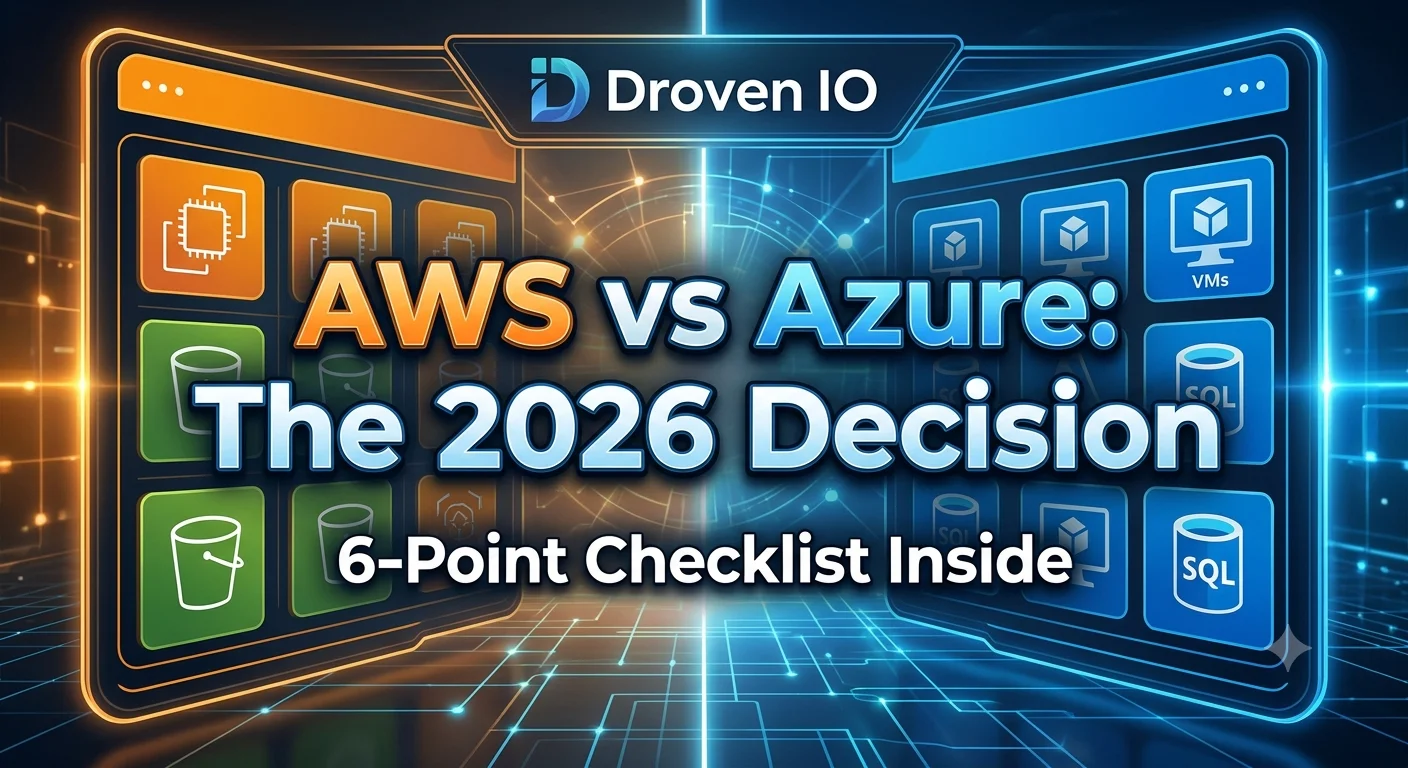
Every “AWS vs Azure” article eventually lands on the same conclusion: it depends. That’s true, but it’s also useless if nobody tells you what it depends on. This Droven IO AWS vs Azure comparison skips the usual side-by-side spec dump. Instead, it gives you a checklist — six criteria that actually decide which platform wins for your specific situation, plus a scoring system you can run in ten minutes.
Why “Which Cloud Is Better” Is the Wrong Question
Amazon Web Services and Microsoft Azure are both mature, enterprise-grade cloud platforms. Neither is “bad.” AWS has the largest service catalog and the longest track record; Azure has the deepest hooks into Microsoft’s enterprise ecosystem and a fast-growing AI portfolio tied to OpenAI’s models. Comparing them feature-for-feature produces two nearly identical lists, each with a different product name attached.
The more useful question is: given your budget, team, existing stack, and compliance requirements, which platform removes the most friction? That’s what the checklist below is built to answer.
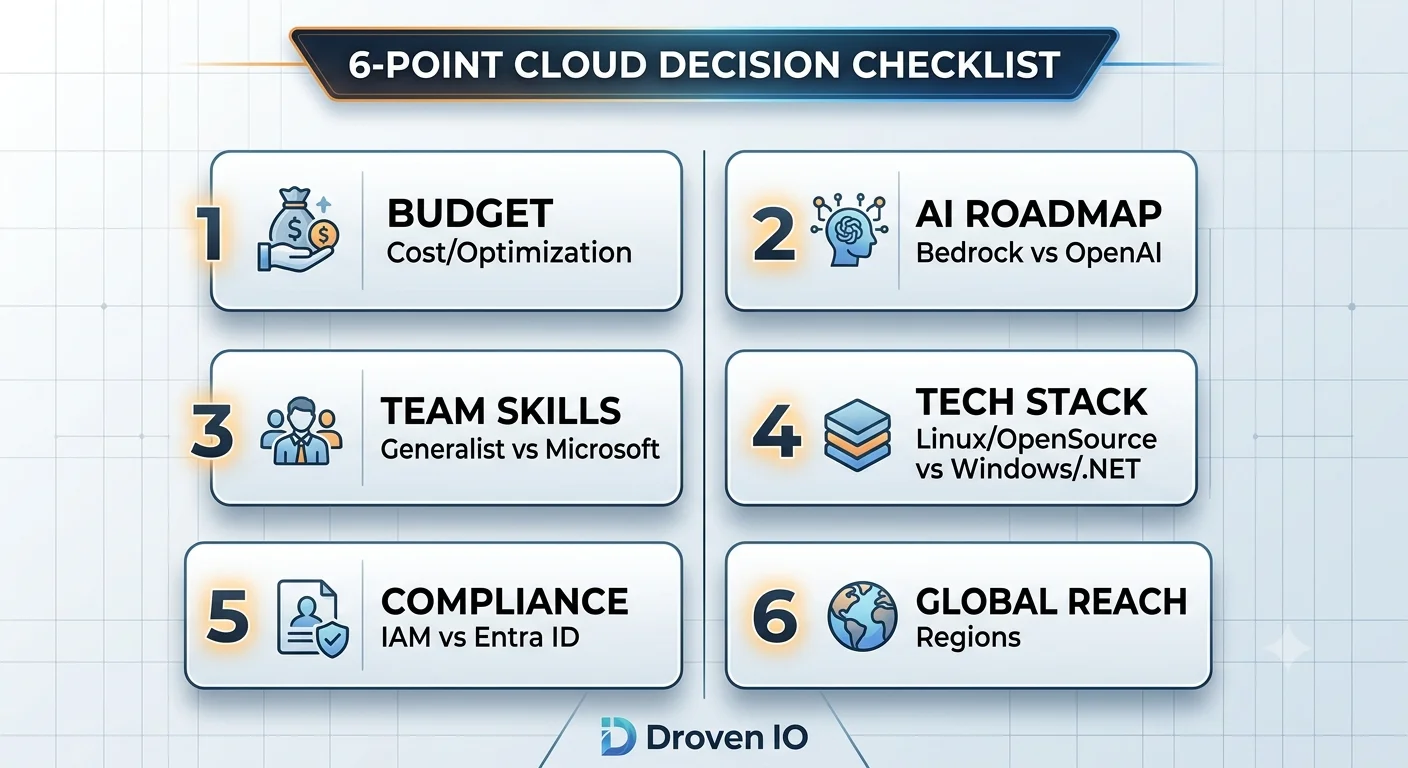
The 6-Point Cloud Decision Checklist
1. Budget & Pricing Model
Both platforms use consumption-based pricing, but they price things differently enough to matter. AWS tends to have more granular (and more complex) pricing tiers across compute, storage, and data transfer — great for optimization if you have a FinOps team, overwhelming if you don’t. Azure’s pricing calculator and hybrid-benefit discounts (for organizations already paying for Windows Server or SQL Server licenses) can meaningfully lower the total cost of ownership if you’re already a Microsoft shop.
Rule of thumb: if you already have Microsoft licensing, run the Azure hybrid benefit numbers before assuming AWS is cheaper — the sticker-price comparison alone is misleading.
Droven.io Cloud Computing Guide: A Practical Decision Framework for 2026
2. AI & Machine Learning Roadmap
This is the fastest-moving criterion, and it’s the one most “AWS vs Azure” articles treat as an afterthought. Azure’s tight integration with OpenAI’s models through Azure OpenAI Service has made it the default choice for teams that want managed access to GPT-family models with enterprise data controls layered on top. AWS’s answer, Amazon Bedrock, takes a model-agnostic approach — you can call Anthropic’s Claude, Meta’s Llama, Amazon’s own Titan models, and others through a single API, which appeals to teams that don’t want to lock into a single model vendor.
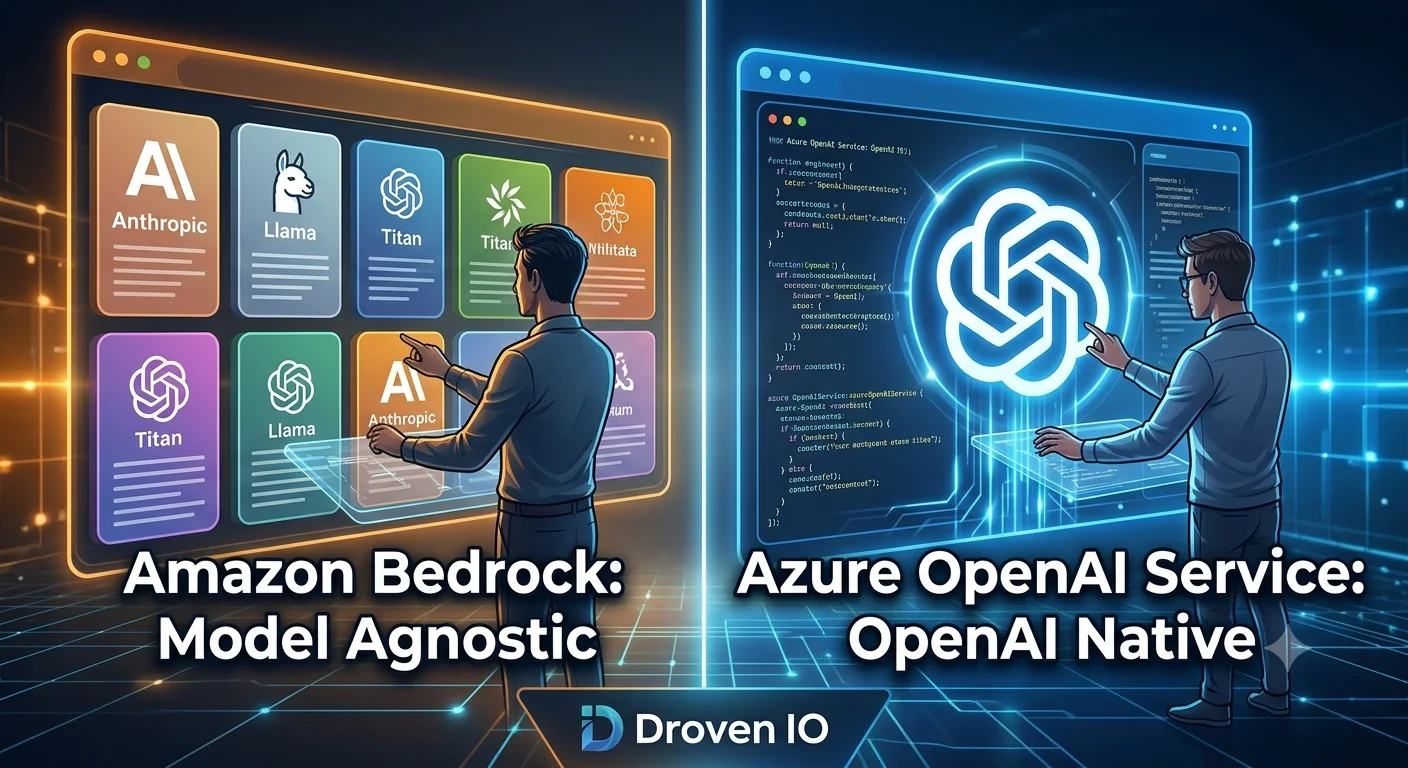
If your roadmap is “we need one flagship model with strong compliance guardrails,” Azure’s AI services usually get you there faster. If your roadmap is “we want to swap models as the landscape shifts,” AWS’s model-agnostic approach is built for that.
3. Team Skills & Learning Curve
AWS has a larger community, more third-party courses, and more Stack Overflow answers simply by virtue of being older and more widely adopted — which matters when you’re hiring or troubleshooting at 2 a.m. Azure’s interface and terminology map more naturally onto teams who already think in Windows Server, Active Directory, and .NET terms, which shortens onboarding for that specific profile of engineer.
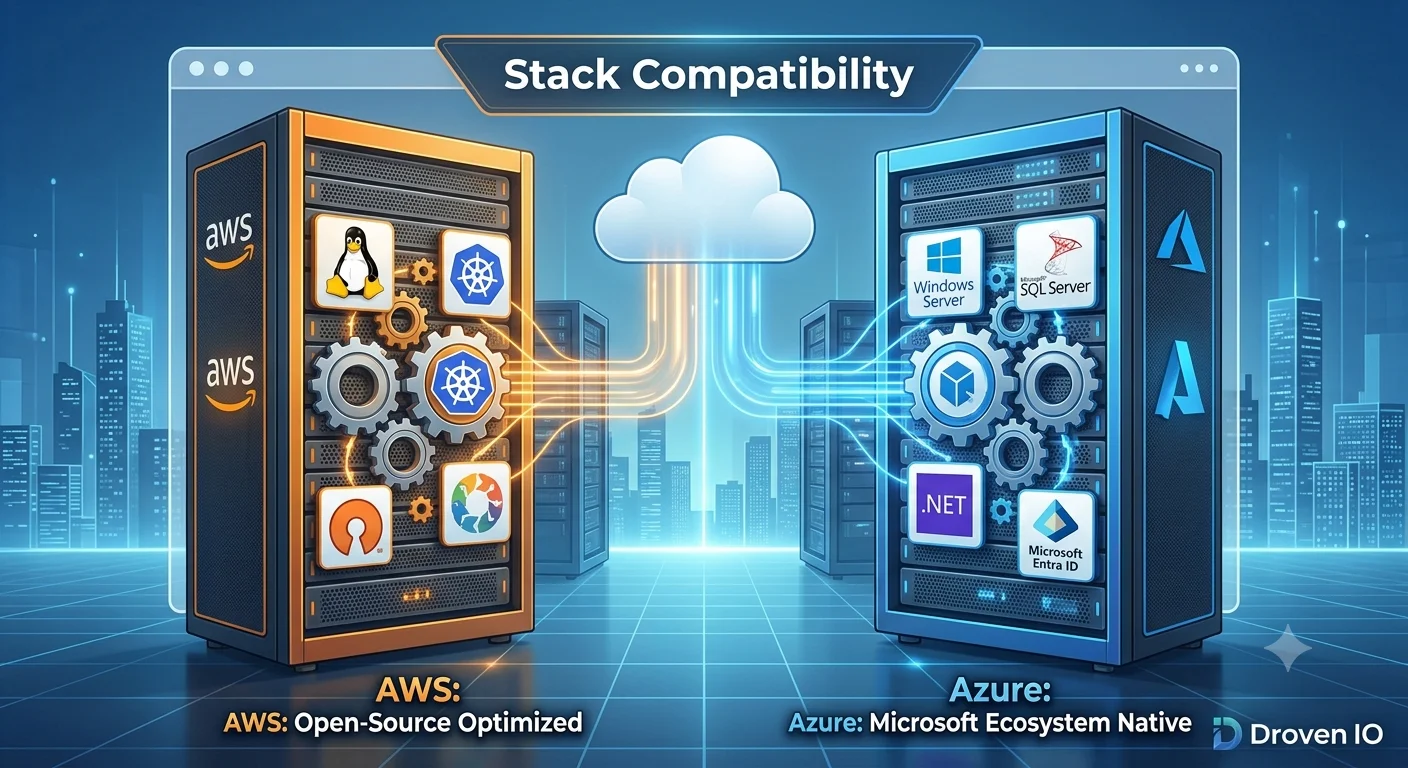
Neither is “easier” in the abstract. Azure is easier for Microsoft-stack teams. AWS is easier for teams hiring generalist cloud engineers.
4. Existing Tech Stack
This is the criterion people skip and then regret. If your organization runs primarily on Windows Server, SQL Server, .NET, and Active Directory, Azure’s native integrations eliminate much of the glue work. If you’re Linux-first, container-native, or already deep in the open-source tooling ecosystem, AWS’s broader third-party integration support and longer history with Kubernetes (via EKS) tend to fit more naturally alongside services like AKS on the Azure side, offering comparable but distinctly flavored tooling.
About Droven.io USA: AI, IT Services, DevOps, RPA & Best AI Jobs Guide (2026)
5. Compliance & Security Needs
Both platforms hold the major compliance certifications (SOC 2, ISO 27001, HIPAA, FedRAMP, etc.), so “which one is more secure” is largely a wash at the certification level. The real difference shows up in governance tooling: Azure’s integration with Microsoft Entra ID (formerly Azure AD) gives Microsoft-centric organizations a more unified identity and access management layer out of the box. AWS’s Identity and Access Management (IAM) is more granular and flexible but has a steeper configuration learning curve — powerful, but easier to misconfigure if your team is new to it.
If regulatory audits are a recurring headache, whichever platform your compliance team already understands is worth more than the one that is “more secure” on paper.
6. Scale & Global Reach
Both AWS and Azure operate in dozens of regions worldwide with strong multi-region redundancy and disaster recovery options. At true global-enterprise scale, the difference tends to come down to which regions matter for your specific customer base and data residency requirements — this is worth checking directly against each provider’s current region map rather than relying on generic “AWS has more regions” claims, since both are expanding constantly.
AWS vs Azure at a Glance
| Compute | EC2, Lambda (serverless) | Virtual Machines, Azure Functions |
| Storage | S3 | Blob Storage |
| Containers | EKS (Kubernetes), ECS | AKS (Kubernetes) |
| AI Services | Amazon Bedrock (multi-model) | Azure OpenAI Service (OpenAI-native) |
| Identity | IAM | Microsoft Entra ID |
| Best existing-stack fit | Linux, open-source, container-native | Windows Server, .NET, Active Directory |
| Pricing edge | Granular, optimizable with FinOps effort | Hybrid Benefit discounts for existing MS licenses |
| Community & hiring pool | Larger, more third-party resources | Strong within Microsoft-centric enterprises |
Score Yourself: Which Platform Wins For You?
Give yourself one point toward AWS or Azure for each statement that’s true for your team:
- We already pay for Windows Server, SQL Server, or Microsoft 365 licensing → Azure.
- We want a single, tightly integrated flagship AI model with enterprise controls → Azure.
- Our team is Linux-first or heavily container-native → AWS.
- We want to switch between multiple AI models without re-architecting → AWS.
- Our hiring pool skews toward generalist cloud engineers, not Microsoft specialists → AWS
- Our compliance team already understands Active Directory-style identity management → Azure.
- We have (or plan to build) a dedicated FinOps function to optimize granular pricing → AWS.
More checks on one side isn’t a guarantee — it’s a starting point for the conversation your engineering and finance teams need to have anyway.
What is Droven.io? USA IT Services Explained (2026)
When the Real Answer Is “Both”
A growing number of mid-size and enterprise teams don’t pick one — they run a multi-cloud strategy, using Azure for Microsoft-integrated workloads and internal tooling while running customer-facing or AI-heavy workloads on AWS (or vice versa). This adds operational overhead, so it’s not the default recommendation for smaller teams. For organizations already straddling both ecosystems through acquisitions or historical decisions, treating cloud migration as an “AWS vs Azure” binary can waste more effort than it saves.

Our Verdict
There’s no universal winner in this Droven IO AWS vs Azure comparison, and any article that gives you one is skipping the part of the analysis that actually matters to your business. As a general pattern:
- Choose Azure if you’re already a Microsoft-licensed enterprise, want tight integration with OpenAI, or have a compliance stack built around Active Directory.
- Choose AWS if you’re Linux- and container-native, want flexibility across AI models, or are hiring from a broader generalist cloud talent pool.
- Consider both if you’re large enough that different teams have already built strong workflows on each platform.
Run the checklist above with your actual team before committing — the right answer lives in your stack and your org chart, not in a spec sheet.
FAQ
Not universally. Azure often comes out cheaper for organizations with existing Microsoft licensing thanks to hybrid-benefit pricing; AWS can be cheaper for teams willing to invest in granular cost optimization. Run both calculators against your actual workload before assuming either is the budget option.
It depends on your approach. Azure OpenAI Service is the stronger pick if you want deep, managed integration with a single flagship model family. Amazon Bedrock is the stronger pick if you want to run and compare multiple AI model providers on a single platform.
Both hold equivalent major compliance certifications. Security outcomes in practice depend more on your team’s familiarity with each platform’s identity and access tooling than on any inherent security gap between the two.
Azure is easier for teams already fluent in Windows Server and Active Directory. AWS is easier for teams with general Linux and open-source cloud experience, largely due to its larger base of community resources.
Beginners planning to work with Microsoft-stack employers should start with Azure; beginners aiming for the broadest range of cloud engineering roles will find more entry-level resources and job listings built around AWS.
Final Conclusion:
There is no “better” cloud—there is only the cloud that fits your current reality.
After reviewing the 6-point checklist, remember:
- Choose Azure if your infrastructure is built on Microsoft foundations, your compliance relies on Entra ID (Active Directory), and you want a direct path to OpenAI’s flagship models.
- Choose AWS if you operate in a Linux/open-source environment, prioritize switching between multiple AI model providers, or have a team that leans into generalist cloud engineering.
The Golden Rule: Migration cost or the friction of “doing it the hard way” usually outweighs the theoretical benefits of the “superior” platform. If your team is already fluent in one, that familiarity is often your most valuable asset.