

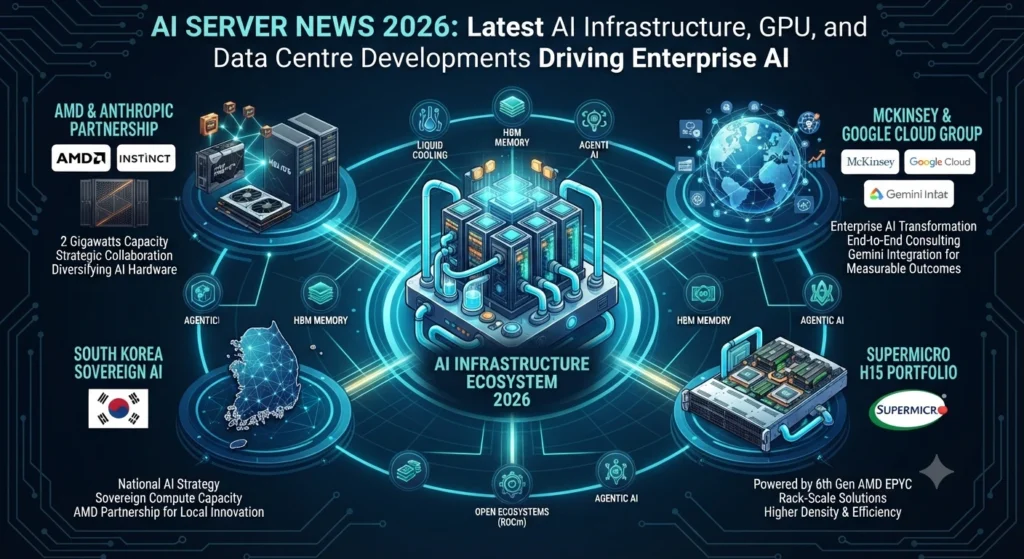
Artificial intelligence is no longer defined solely by breakthroughs in large language models or generative AI applications. Behind every AI assistant, recommendation engine, autonomous system, and enterprise chatbot is a rapidly expanding infrastructure ecosystem built on advanced servers, high-performance GPUs, networking technologies, and hyperscale data centres.
Throughout 2026, the conversation around AI has shifted from who has the smartest model to who can build and operate the most efficient AI infrastructure. Hardware manufacturers, cloud providers, consulting firms, and governments are investing billions of dollars to secure computing capacity capable of supporting increasingly complex AI workloads.
Recent announcements from AMD, Anthropic, Supermicro, Google Cloud, and McKinsey demonstrate that enterprise AI is entering a new phase. Rather than purchasing standalone hardware, organisations are investing in complete AI platforms that combine computing infrastructure, software, AI models, and transformation services into integrated ecosystems.
In this article, we examine the most significant AI server developments of 2026, explain why they matter for businesses, and explore the major trends shaping the future of AI infrastructure.
What Is an AI Server?
An AI server is a specialised computing system designed to train, fine-tune, and deploy artificial intelligence models. Unlike conventional enterprise servers that primarily run business applications or websites, AI servers are optimised for computationally intensive machine learning workloads.
Modern AI servers typically combine:
- High-performance GPUs
- Multi-core CPUs
- High-bandwidth memory (HBM)
- Ultra-fast networking technologies
- AI software frameworks
- Large-scale storage systems
These components work together to process enormous datasets and perform the trillions of mathematical calculations required by today’s AI models.
AI servers now support applications across numerous industries, including:
- Generative AI
- Large language models (LLMs)
- Computer vision
- Healthcare research
- Financial analytics
- Scientific simulations
- Manufacturing automation
- Autonomous vehicles
- Robotics
As enterprise AI adoption accelerates, demand for specialised AI infrastructure continues to grow worldwide.
Why AI Infrastructure Demand Continues to Rise
Several long-term trends are driving unprecedented investment in AI computing infrastructure.
Enterprise AI Is Moving Beyond Experiments
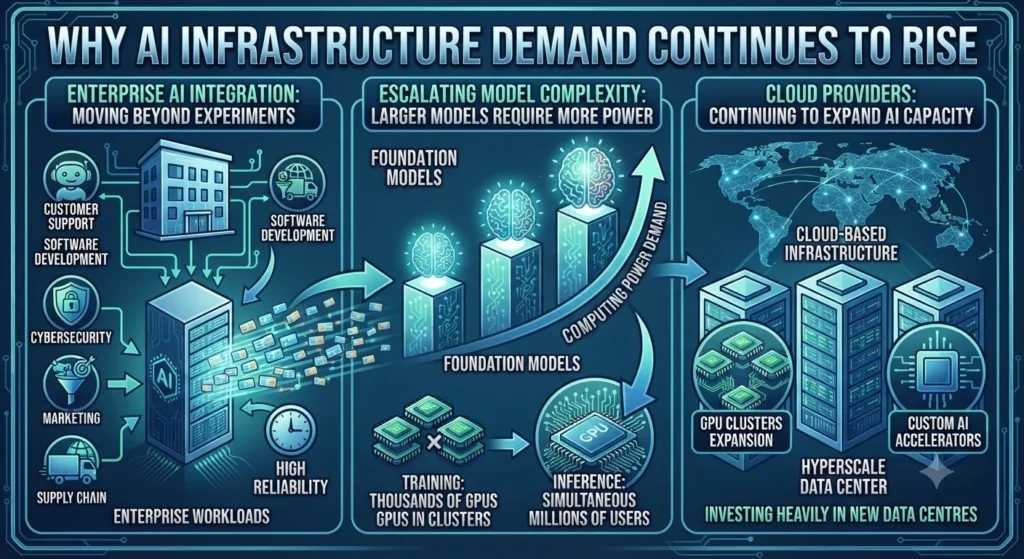
Organisations are no longer evaluating AI through isolated pilot projects. Instead, businesses are integrating AI into customer support, software development, cybersecurity, marketing, supply chain management, and internal operations.
Running these workloads at enterprise scale requires infrastructure capable of processing thousands—or even millions—of AI requests every day with low latency and high reliability.
Larger AI Models Require More Computing Power
Every new generation of foundation models demands greater computational resources.
Training frontier AI models now requires thousands of GPUs operating together inside large AI clusters. Even inference—the process of generating responses after a model has been trained—requires significant computing power when millions of users access AI services simultaneously.
As models continue growing in size and complexity, AI infrastructure has become one of the industry’s most valuable strategic assets.
Cloud Providers Continue Expanding AI Capacity
Instead of purchasing expensive on-premises hardware, many organisations increasingly rely on cloud-based AI infrastructure.
This shift has encouraged major cloud providers to expand GPU clusters, develop custom AI accelerators, and invest heavily in new data centres capable of supporting next-generation AI workloads.
AMD and Anthropic Announce One of 2026’s Largest AI Infrastructure Partnerships
One of the year’s biggest infrastructure announcements came from AMD and Anthropic.
The companies revealed plans for a long-term strategic partnership centred on AMD’s next-generation AI infrastructure. Anthropic intends to deploy up to two gigawatts of AI computing capacity using AMD Helios rack-scale systems powered by AMD Instinct GPUs.
The deployment is expected to begin in 2027 and represents one of the largest publicly announced AI infrastructure projects involving an alternative to NVIDIA’s GPU ecosystem.
The collaboration extends beyond hardware deployment. Anthropic will also work with AMD engineers to optimise AI workloads using the ROCm software platform while contributing improvements that strengthen AMD’s broader AI software ecosystem.
Source:
AMD additionally announced plans for a strategic equity investment in Anthropic, highlighting how hardware vendors are increasingly forming long-term partnerships with leading AI developers rather than acting solely as component suppliers.
Why This Partnership Matters
For years, NVIDIA has dominated the AI accelerator market. AMD’s partnership with Anthropic signals that large AI companies are actively diversifying their infrastructure strategies.
Competition among GPU vendors could encourage:
- Greater hardware innovation
- Improved software ecosystems
- Lower infrastructure costs
- Better supply-chain resilience
- Increased customer choice
Rather than competing only on processor performance, AI infrastructure providers are now competing across the entire technology stack—from silicon and networking to software, deployment tools, and enterprise support.
McKinsey and Google Cloud Expand Enterprise AI Transformation
Another significant development in 2026 came from McKinsey and Google Cloud, which announced the McKinsey Google Transformation Group. Unlike traditional infrastructure partnerships focused solely on hardware, this initiative combines AI technology, business strategy, and enterprise transformation into a single operating model.
The collaboration brings together McKinsey’s consulting expertise with Google Cloud’s AI platform, including Gemini models, AI infrastructure, compute accelerators, and Gemini Enterprise. The objective is to help organisations move beyond limited AI pilots and deploy AI across entire business functions with measurable outcomes.
Instead of offering isolated consulting projects, the new group provides end-to-end support covering AI opportunity assessments, transformation planning, minimum viable product (MVP) development, enterprise deployment, governance, and change management.
Source:
Real Enterprise Examples
The partnership also highlights several organisations already demonstrating measurable AI adoption.
Indosat Ooredoo Hutchison, one of Indonesia’s leading telecommunications providers, is using Google Cloud AI technologies and Gemini models as part of its AI-native transformation. According to the announcement, the program is expected to generate more than $360 million in cumulative EBITDA by 2027, support more than 80 concurrent AI use cases, and enable over 90% of employees to become regular AI users.
The collaboration also extends to CBRE, which is deploying agentic AI across multiple business domains, and Formula E, where Google Cloud and McKinsey are helping integrate AI into analytics, engineering, and operational workflows.
These examples illustrate an important shift in enterprise AI. Businesses are increasingly seeking measurable operational improvements rather than experimenting with standalone AI tools.
AMD Partners with South Korea to Advance Sovereign AI Infrastructure
Another major announcement shaping AI infrastructure in 2026 came from AMD’s strategic collaboration with South Korea’s Ministry of Science and ICT (MSIT). Rather than focusing solely on hardware procurement, the partnership aims to strengthen the country’s long-term sovereign AI capabilities through open computing platforms, domestic innovation, and workforce development.
The initiative includes several areas of collaboration:
- National AI infrastructure development
- AI semiconductor research
- Open-source AI software
- University and research partnerships
- AI talent development
- High-performance computing centres
- Physical AI research
A key objective is integrating AMD’s CPUs and GPUs with Korean-developed Neural Processing Units (NPUs), allowing organisations to build heterogeneous AI environments instead of relying on a single hardware vendor.
AMD also plans to establish an AI Centre of Excellence in South Korea, supporting software optimisation, developer education, academic research, and collaboration with local AI startups.

Source:
AMD and Korea’s Ministry of Science and ICT Partner to Advance a Sovereign AI Ecosystem
Why Sovereign AI Matters
Governments increasingly recognise artificial intelligence as critical national infrastructure.
Instead of depending entirely on foreign cloud providers, many countries are investing in domestic AI ecosystems that support economic competitiveness, digital sovereignty, national security, and local innovation.
South Korea joins a growing number of nations investing in sovereign AI initiatives designed to combine local infrastructure with global technology partnerships.
For infrastructure vendors such as AMD, these initiatives represent long-term opportunities extending far beyond traditional enterprise customers.
Supermicro Expands Its AI Server Portfolio
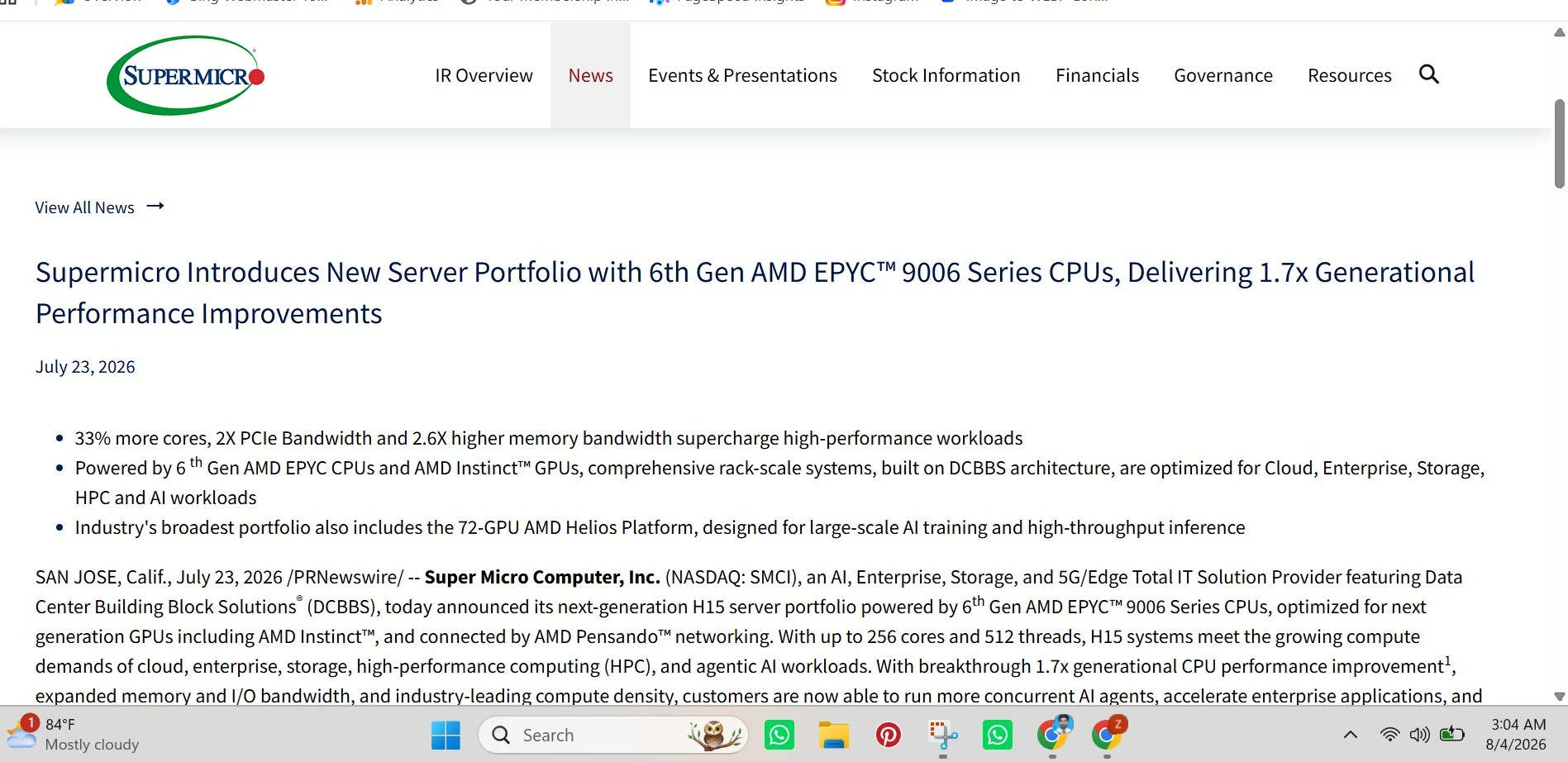
Supermicro also introduced one of the most significant enterprise server announcements of the year with its latest H15 server portfolio powered by 6th Generation AMD EPYC™ 9006 Series processors.
The new systems target demanding workloads including:
- Artificial Intelligence
- High-Performance Computing (HPC)
- Enterprise applications
- Cloud computing
- Large-scale storage
- Virtualisation
- Agentic AI
Compared with previous generations, the new platform delivers improvements in compute density, memory bandwidth, PCIe connectivity, and power efficiency.
The processors support:
- Up to 256 CPU cores
- Up to 512 processing threads
- Higher memory bandwidth
- Faster PCIe connectivity
- Improved energy efficiency
These capabilities enable enterprises to consolidate workloads while supporting increasingly complex AI applications.
Source:
AI Infrastructure Beyond Individual Servers
One of the most notable aspects of Supermicro’s announcement is its emphasis on complete rack-scale AI infrastructure instead of standalone servers.
Its portfolio now includes specialised platforms such as:
- Hyper Systems
- CloudDC Servers
- GrandTwin Architecture
- FlexTwin Systems
- Petascale Storage
- SuperBlade Solutions
Rather than asking customers to assemble infrastructure from multiple vendors, these integrated platforms simplify deployment while improving compatibility and operational efficiency.
Rack-Scale Computing Is Becoming the Industry Standard
One of the clearest infrastructure trends emerging in 2026 is the transition from individual GPU servers to rack-scale AI systems.
Modern AI models frequently require thousands of GPUs operating together with extremely low latency.
Rack-scale architectures combine:
- AI accelerators
- CPUs
- Networking
- High-speed storage
- Power distribution
- Cooling systems
- AI software
into a unified platform optimised for large-scale AI training and inference.
This approach offers several advantages:
- Faster deployment
- Better scalability
- Lower networking latency
- Simplified infrastructure management
- Improved power efficiency
- Consistent performance across AI clusters
As AI workloads continue expanding, rack-scale infrastructure is expected to become the preferred deployment model for hyperscalers, research organisations, and enterprise AI environments.
Top AI Infrastructure Trends in 2026
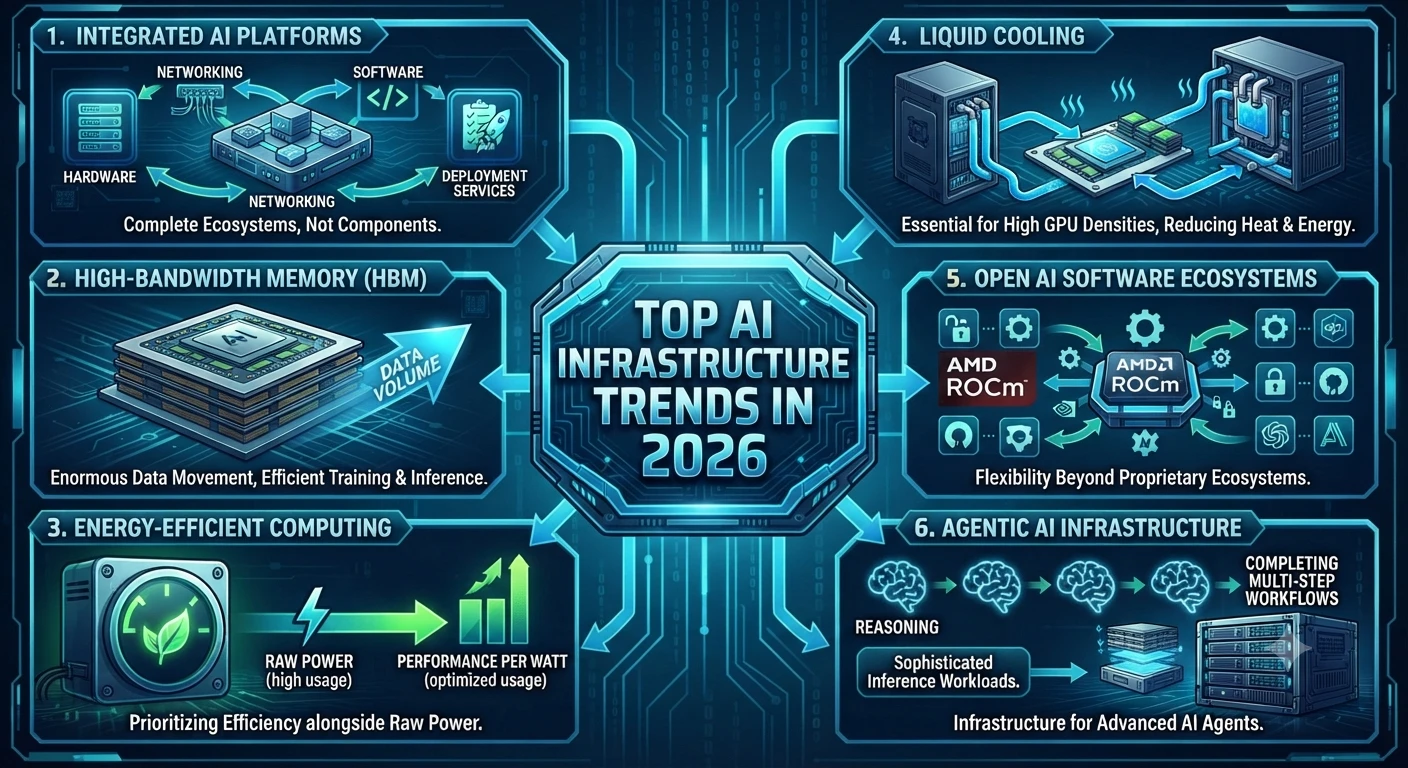
Several technology trends are defining the next generation of AI computing.
1. Integrated AI Platforms
Organisations increasingly prefer complete infrastructure ecosystems that combine hardware, networking, software, and deployment services rather than purchasing individual components separately.
2. High-Bandwidth Memory (HBM)
Modern AI accelerators depend heavily on HBM to move enormous volumes of data efficiently, reducing training times and improving inference performance.
3. Energy-Efficient Computing
With AI data centres consuming unprecedented amounts of electricity, infrastructure vendors are prioritising performance per watt alongside raw computing power.
4. Liquid Cooling
Higher GPU densities generate significantly more heat than traditional enterprise servers.
Liquid cooling is becoming essential for supporting next-generation AI clusters while reducing energy consumption.
5. Open AI Software Ecosystems
Software platforms such as AMD ROCm continue expanding, giving developers additional flexibility beyond proprietary AI ecosystems.
6. Agentic AI Infrastructure
The emergence of AI agents capable of reasoning and completing multi-step workflows is driving demand for infrastructure capable of handling more sophisticated inference workloads.
Challenges Facing AI Server Deployments
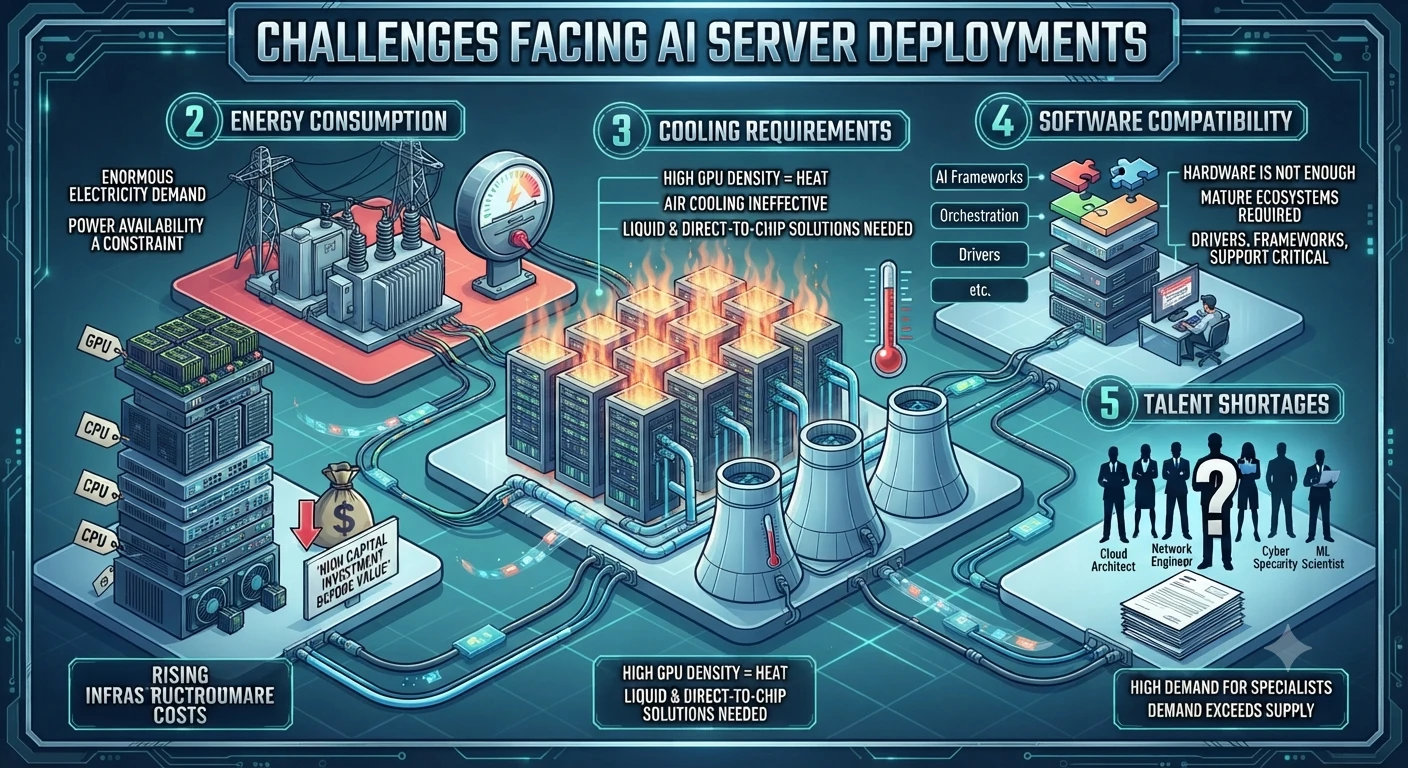
Despite rapid investment, organisations still face several obstacles when deploying AI infrastructure.
Rising Infrastructure Costs
AI servers remain expensive because they combine high-performance GPUs, CPUs, networking equipment, storage systems, and advanced cooling technologies.
Large enterprise deployments often require substantial capital investment before delivering measurable business value.
Energy Consumption
Training frontier AI models consumes enormous amounts of electricity.
Power availability is becoming one of the most important constraints affecting AI data-centre expansion worldwide.
Cooling Requirements
As GPU density increases, conventional air cooling becomes less effective.
Many hyperscale AI facilities are adopting direct-to-chip and liquid cooling technologies to maintain performance while improving energy efficiency.
Software Compatibility
Hardware performance alone is no longer enough.
Organisations require mature software ecosystems, optimised drivers, AI frameworks, orchestration tools, and developer support to maximise infrastructure investments.
Talent Shortages
Building AI infrastructure requires specialists in cloud architecture, networking, GPU optimisation, cybersecurity, and machine learning.
Demand for experienced AI infrastructure professionals continues to exceed supply.
What Businesses Should Consider Before Investing
Organisations planning AI infrastructure investments should evaluate more than processor specifications.
Important considerations include:
- Business objectives
- Expected AI workloads
- Total cost of ownership
- Cloud versus on-premises deployment
- Scalability requirements
- Software ecosystem maturity
- Vendor support
- Regulatory compliance
- Security requirements
- Future upgrade paths
Selecting infrastructure based solely on hardware performance may create long-term operational challenges.
A balanced evaluation of hardware, software, operational costs, and ecosystem maturity typically produces better long-term outcomes.
Frequently Asked Questions
What is an AI server?
An AI server is a high-performance computing system designed specifically for training and running artificial intelligence models, using specialised hardware such as GPUs, high-speed networking, and optimised software.
Why are GPUs essential for AI servers?
GPUs perform thousands of mathematical operations simultaneously, making them significantly faster than traditional CPUs for machine learning and deep learning workloads.
What is rack-scale AI infrastructure?
Rack-scale infrastructure integrates servers, GPUs, networking, storage, and cooling into a unified platform optimised for large-scale AI training and inference.
What is Sovereign AI?
Sovereign AI refers to a country’s ability to develop, deploy, and govern AI infrastructure using technologies, policies, and computing resources aligned with national priorities.
Why are consulting firms partnering with cloud providers?
Enterprise AI success increasingly depends on business transformation rather than technology alone. Partnerships such as the McKinsey Google Transformation Group combine AI platforms, industry expertise, implementation, and governance to help organisations achieve measurable business outcomes.
Conclusion
The AI infrastructure landscape is evolving faster than ever. While advances in generative AI continue to capture headlines, the real competition is increasingly centred on the computing infrastructure that powers these technologies.
Major announcements throughout 2026—including AMD’s strategic partnership with Anthropic, South Korea’s sovereign AI initiative, Supermicro’s next-generation AI servers, and the launch of the McKinsey Google Transformation Group with Google Cloud—demonstrate that the industry is moving toward integrated ecosystems rather than standalone hardware solutions.
Organisations are no longer investing only in GPUs or servers. They are building scalable AI platforms that combine advanced hardware, cloud infrastructure, AI software, governance, and transformation expertise to support long-term innovation.
For businesses, understanding these developments is becoming increasingly important. Infrastructure decisions made today will influence future AI performance, scalability, operational efficiency, and competitiveness. As AI adoption accelerates across industries, organisations that invest strategically in flexible, well-supported, and energy-efficient AI infrastructure will be better positioned to capitalise on the next generation of intelligent applications.
